That Deep Lab Vortex Doesn’t Mean the Liquid Is Mixing Better
What looks like the strongest sign of good mixing in a beaker—a deep vortex funnel—is often a sign that the liquid is doing something more organized, and less useful, than you think. A deeper vortex does not automatically mean better mixing.
Önemli noktaları göster
- A deep vortex does not automatically indicate effective mixing because visible motion and actual composition exchange are different things.
- Magnetic stir bars often create bulk circular flow that makes liquid rotate together instead of mixing rapidly across regions.
- Good mixing depends on radial and vertical exchange, especially between the center, walls, top, and bottom of the beaker.
-
- Wall regions and dead zones can remain poorly refreshed even when the center of the beaker looks active and dramatic.
- Engineers evaluate mixing quality with tracer dyes, conductivity probes, and mixing time measurements rather than appearance alone.
- A simple dye test comparing the center and wall can reveal whether the liquid is truly mixing or just swirling in organized paths.
- While some processes benefit from vortex formation, a showy funnel by itself is not proof of thorough or efficient mixing.
I have spent a lot of time around stir plates, and this is one of the first bad instincts students pick up: if the liquid looks dramatic, the mixing must be excellent. In a beaker, though, motion and mixing are not the same job.
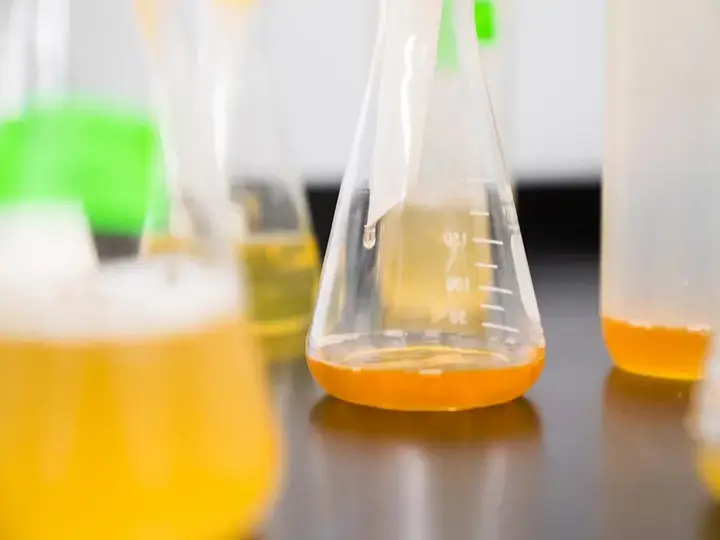
Why the liquid can look busy and still stay badly mixed
A magnetic stir bar mainly pushes the liquid into circular motion. That can make the whole beaker rotate as a bulk flow, with the surface pulled down into a visible funnel, while neighboring layers of liquid keep following fairly orderly paths instead of trading places quickly.
That point is standard in mixing engineering. In Perry’s Chemical Engineers’ Handbook, 8th edition, published by McGraw-Hill in 2008, the discussion of stirred vessels notes that vortex formation is associated with swirling, air entrainment, and poor power use unless the vessel design disrupts that rotation; the concern is not whether the liquid is moving, but whether the motion is actually breaking up uniform circular flow.
A plain beaker on a stir plate makes this easy to miss. Your eye notices the center first, because the funnel is obvious, but the real grading happens elsewhere: whether material near the wall gets drawn in, whether top and bottom exchange, and whether any region keeps circling in its own lane.
Slow the scene down in your head. The stir bar is spinning, the surface dips, and you hear that thin, glassy whir as the bar catches and re-centers at the bottom. It sounds active, even sharp. But what matters is not the sound or the funnel; it is whether liquid from one path is being pushed into another path fast enough to erase differences in composition.
Researchers in mixing and bioprocess labs have measured this kind of thing directly with tracer dyes, conductivity probes, and decolorization tests rather than by judging appearance. For example, a 2004 review by Nienow in Chemical Engineering Research and Design describes how vortexing in stirred vessels can reflect strong bulk circulation and can also bring in air, while actual mixing quality is evaluated by measured mixing time and how quickly a tracer becomes uniform throughout the vessel.
The beaker’s report card has hidden subjects
Here is the first hidden subject: bulk rotation. If much of the liquid is turning together, that looks energetic, but large regions may be moving as a group rather than being folded into one another.
Second: weak radial exchange. Good mixing needs fluid from near the center to swap with fluid near the wall. A neat vortex can keep those paths too tidy.
Third: wall regions. Near the glass, flow can be slower or less connected to the action in the middle. A beaker can look lively in the center and still leave the outer region poorly refreshed.
Fourth: dead zones. That sounds dramatic, but it usually means something plain—places where liquid recirculates sluggishly or gets reached late. If you are dissolving a solid, distributing a reagent, or trying to make a sample uniform, those neglected spots are where errors hide.
And then comes the sneakiest problem: false confidence. A deep funnel gives the eye an easy story—powerful spin, therefore powerful mixing. The beaker accepts that compliment too easily.
Now, to be fair, the opposite case is tempting. The vortex looks forceful, efficient, almost self-evident. If the surface is being pulled downward so strongly, surely material must be getting dragged all through the liquid and mixed faster.
Hard cut: not necessarily. A liquid can move dramatically while staying organized into circulating tracks, and organized tracks are the enemy of fast composition exchange. Mixing is not the same as motion; the right question is not “How deep is the funnel?” but “How quickly do different parts of the beaker exchange places and concentration?”
A simple test that catches the eye when the eye is wrong
Try a thought experiment with a drop of dye. Put one drop near the center and another near the wall. If the system is mixing well, both should spread through the whole beaker fairly quickly, with the color differences fading as fluid elements cross paths again and again.
If the liquid is mostly swirling, you get something else. The center drop gets swept into the main circulation, the wall drop may linger or travel on a different timetable, and the color can stretch into loops before it truly evens out. That is motion, yes. It is not yet proof of good mixing.
This is also why chemists and engineers often judge mixing by distribution or mixing time, not by spectacle. A vessel earns a good grade when it reduces concentration differences throughout the volume, reaches the edges, and clears out slow regions—not when it simply puts on the best whirlpool.
There is one honest limit here. Not every vortex is bad. In some setups, operators do want surface liquid pulled downward, or they want stronger gas transfer, or they are blending something where a certain amount of vortex formation helps the process. But a deep funnel by itself is not proof of thorough mixing.
What to trust instead of the showy funnel
When you watch a beaker on a stir plate, judge it like a teacher grading the full paper, not the flashy first line. Ask whether the liquid is exchanging across layers, whether the outer region is getting involved, and whether differences in color, solute, or temperature would disappear quickly everywhere, not just in the center.
That one shift in thinking is useful far beyond one beaker. Once you stop equating visible drama with good mixing, lab work gets calmer and better. You start looking for distribution, not theater.
So keep the little dye test in your head: center versus wall, swirling versus exchange. Good science gets quieter as your judgment gets sharper, and that is a satisfying trade.