5 Fascinating Facts About King Penguins You Must Know
Cold salt in the air, two upright birds bracing on rock as spray comes across them, and yet you are looking at one of the finest diving hunters in the Southern Ocean. King penguins can seem slow, formal, almost ceremonial on land, but underwater they are fast, exact, and built for hard work in cold seas.
Önemli noktaları göster
- King penguins routinely dive beyond 100 meters and often reach several hundred meters while foraging.
- Their streamlined bodies, long beaks, and flipper-driven swimming make them highly efficient underwater hunters.
- They prey on slippery animals such as lanternfish and squid in dim, cold ocean waters.
-
- Their outer feathers shed water while dense insulation underneath helps retain heat in freezing seas.
- Researchers have recorded king penguins cruising at about 2 meters per second, with faster bursts during hunting.
- They extend dives through large blood volumes, strong oxygen-binding capacity, and careful use of muscle oxygen stores.
- Although they appear poised and ceremonial on land, king penguins are specialized marine foragers shaped primarily by life at sea.
That is not just a storyteller’s flourish. The British Antarctic Survey and long-running biologging work on king penguins have shown that these birds routinely dive for food at depths of more than 100 meters, and often much deeper, with foraging dives commonly reaching several hundred meters. A 1993 study by Yves Cherel and Henri Weimerskirch in Proceedings of the National Academy of Sciences, working with free-ranging king penguins from Crozet Islands, documented repeated deep dives as part of normal feeding, not rare stunt performance.
They look dressed for shore, but they are engineered for sea
Stand still for a moment with a king penguin in your mind and the first things you notice are plain enough: the upright posture, the clean black-and-white line, the long beak, the orange at the sides of the head and throat. On land, those features can read as tidy and handsome. In the water, they make more sense.
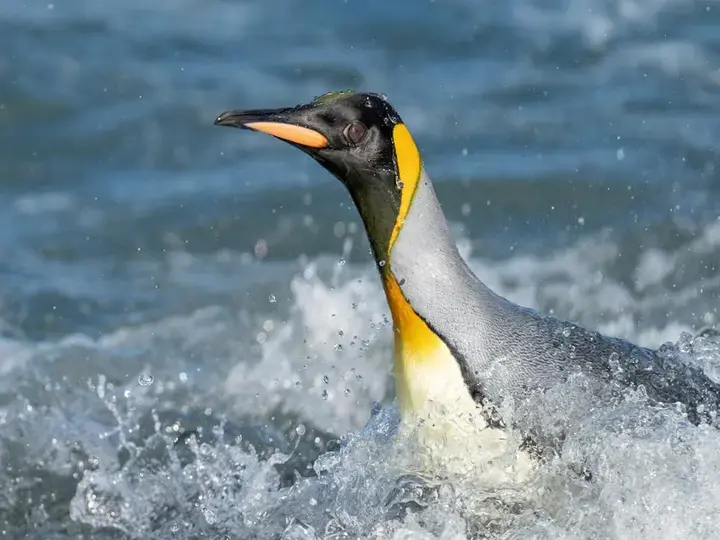
That upright stance is the least important thing about them once they leave the rocks. It is useful ashore, where they must balance, rest, shuffle, and hold themselves above the cold ground, but it can fool us into thinking this is a land bird that happens to swim. It is really the other way around: a marine hunter that comes ashore when it must.
Look at the body line. King penguins are narrow through the water, with the head flowing into the neck and trunk in a smooth shape that reduces drag. Their beak is elongated and practical rather than cute, a tool for seizing slippery prey such as lanternfish and squid in dim cold water.
And those orange patches on the head and upper throat, bright as they are, are not mere decoration. They help make king penguins easy to identify among penguins, and researchers have linked colorful ear and breast patches in penguins to social signaling and mate assessment. Still, it is worth being honest here: not every visible mark comes with one neat, fully settled explanation, and the orange is best understood as part of a signaling system layered onto a body whose main business is survival at sea.
Now think about the feathers, because that is where the shoreline illusion starts to break. After a blast of cold sea spray, a king penguin’s outer plumage would feel tight, waxy, and closely layered under the hand, not fluffy in the way people often imagine. That texture is the point. The outer feathers help shed water, and beneath them lies dense insulation that keeps body heat in when the surrounding sea is trying to take it away.
If you want a quick self-check, picture the freezing surf instead of the beach. Which traits matter more there: a soft, warm-looking coat, or a tightly packed, water-resistant surface wrapped around a streamlined body? The answer tells you what kind of bird this really is.
Then the whole timescale changes. On shore, a king penguin can seem patient almost to stillness. Underwater, that same bird turns into something else entirely.
Fast. Direct. Efficient.
Researchers using animal-borne recorders have found king penguins cruising underwater at speeds around 2 meters per second, with bursts higher than that during active hunting. They do not blunder through the sea. They steer with flipper strokes and body angle, descend in controlled arcs, and use their oxygen stores so well that dives of several minutes are ordinary. A 2010 review by Rory Wilson and colleagues in Marine Ecology Progress Series, drawing on instrumented seabirds including penguins, helped show just how finely tuned these birds are in balancing speed, drag, and energy use underwater.
The calm posture hides a machine built for pressure and cold
This is the part that changes your whole reading of them. The sleek black-and-white plumage is not formal wear; it is a waterproof outer system over insulation. The beak is not elegant by accident; it suits grabbing prey below the surface. Even the neat, composed look on land comes from a body that wastes little.
King penguins also carry more oxygen in useful ways than you might expect from a bird. Work by Paul Ponganis and colleagues on diving seabirds has shown how penguins rely on large blood volumes, strong oxygen-binding capacity, and careful use of muscle oxygen stores to extend dives. King penguins are not the deepest-diving penguin on Earth, but they are among the great sustained foragers of cold subantarctic waters, covering long distances and repeating hard dives again and again.
Their colony setting matters too, though not for the sentimental reason people often assume. A crowded breeding place can make them seem domestic, almost familiar. But the colony is only the landward knot in a much bigger life that stretches out over rough ocean, where birds must leave, find patchy prey, return, and do it over and over in conditions that would empty most animals fast.
You might say plenty of seabirds swim well, so why single out king penguins? Fair point. The answer is that king penguins are not simply birds that can swim; they are birds whose whole visible design is tied to cold-water diving, repeated submergence, and precision hunting. The charm people notice first is real, but it sits on top of heavy-duty specialization.
Why they deserve more than a passing smile
Once you know that, the orange throat patches stop looking like flourish and start looking like part of a complete working animal. The sleek coat is no longer just pretty. The long beak no longer seems fussy. The upright stillness is not passivity at all; it is what a sea hunter looks like when it is briefly on land.
There is something satisfying in that correction. A king penguin does not need us to make it grander than it is. It only needs us to see clearly that the quiet bird on the rocks belongs to a harder world than its calm posture suggests.
So the next time a king penguin seems almost motionless by the shore, see the stored design inside that still body: the tight feathers, the practiced balance, the beak ready for pursuit, the strength held back until it meets the water. That is a good kind of respect to carry away—calm, accurate, and earned.