You and the Penguins: Discovering Their World
They can look faintly comic and still carry themselves with real dignity—especially when they stand upright on a pebbled beach in their black-and-white coats, turn their marked faces toward one another, and pause as if the business of the colony matters very much indeed.
Önemli noktaları göster
- African penguins appear funny at first, but their upright posture and alert behavior give them real dignity.
- Their waddling gait is functional for moving across rough, pebbled shorelines rather than a sign of clumsiness.
- Distinctive facial and chest markings make their movements and social signals seem especially deliberate.
-
- They are highly social colonial seabirds that rely on pair bonds, voice recognition, and close awareness of one another.
- Their donkey-like bray serves as meaningful communication in noisy, windy colonies, not mere comic sound.
- The species is listed as Critically Endangered, which gives added weight to every visible pair and colony gathering.
- Watching their spacing, posture, and mutual attention reveals a coordinated social life that deserves respect as much as affection.
That double impression is not a trick of sentiment. African penguins really do invite a smile with their short steps and earnest braying, yet when you watch them for more than a moment, the joke drops away. What remains is a social wild bird, alert on open ground, reading its companions and being read in return.
Why the Waddle Misleads You
On a sandy shore mixed with shells and small stones, they do not sprawl like clowns after a performance. They hold themselves high. The chest is forward, the head is up, and even the awkward little pebble-step has purpose because these birds are moving over rough footing, not polished floorboards made for our amusement.
The black facial markings help here. African penguins have individually variable spot patterns on the chest and distinctive markings around the face, and those sharp contrasts make every turn of the head seem deliberate. A bird glances left, another answers by shifting closer, and suddenly the beach feels less like a stage than a town square with strict local customs.
They are social birds by habit and by necessity. According to SANCCOB, the Southern African Foundation for the Conservation of Coastal Birds, African penguins breed in colonies and usually return to the same general breeding areas, where pairs recognize one another by voice and behavior. BirdLife International currently lists the species as Critically Endangered, which is a sober fact, but it also tells you something about why each settled pair and each orderly gathering feels weighty when you see it.
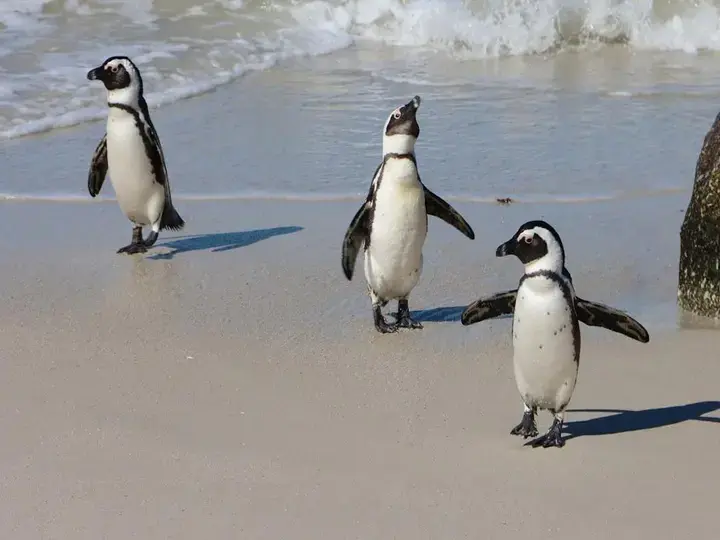
So the signs stack up quickly. Upright stance. Pebble footing. Paired movement. Alert heads. Black markings that sharpen every expression. Braying calls that seem comic only until you notice who answers and who does not.
The Beach Starts Looking Like a Neighborhood
Watch a small group for a few minutes and you begin to see spacing, not crowding. One bird stands just off another’s shoulder. Two move together while a third keeps a respectful bit of distance. A bird settles, another turns, and several keep their heads working like watchmen on a windy corner.
That social order is well known to people who work with the species. The South African National Biodiversity Institute describes African penguins as colonial seabirds, with strong pair bonds and regular vocal communication at nesting sites and gathering areas. They are not simply standing near one another because the beach is convenient. They are living in one another’s awareness.
If you heard that call and watched who answered it, what would you assume about who belongs to whom here?
That is the moment the colony changes in your mind. The donkey-like bray comes carrying over pebbles and surf, a rough old-horn sound that travels farther than the neat little body seems entitled to produce. It is funny for half a second, yes, and then it becomes something else: a public declaration, a locator, a signal thrown into a busy neighborhood where being heard matters.
Dr. Richard Sherley, a seabird researcher who has worked extensively on African penguins, has described their vocal life and colony behavior as central to how they maintain pair and group connections. You do not need special training to feel that seriousness once you have listened properly. You only need to stop treating the noise as a punchline.
What Dignity Looks Like When You Live on Stones and Wind
This is the small revelation at the heart of them: the very traits people laugh at are often the traits that fit colony life on an exposed shore. The waddling gait is what happens when a bird built for powerful swimming moves on land with a short, set-back leg posture. The bray is not absurd decoration. It is communication in a place full of distance, wind, and competing voices.
And dignity, in such a bird, will not look like smooth elegance from one end of the body to the other. It looks like steadiness. It looks like standing your ground on loose pebbles. It looks like turning toward a partner with instant attention. It looks like holding formation in a restless group and keeping your place without fuss.
I should be fair here: one beach scene, however revealing, does not capture every African penguin group or every mood inside a colony. Birds rest, quarrel, court, guard, and loaf in different ways depending on season and place. Still, even a short watch is enough to show that the social texture is real, not imagined into them by fond humans.
People often flatten penguins into slapstick because the body shape is easy to caricature and the call sounds borrowed from a barnyard. That is our surface reading, not theirs. Look a little longer and the posture, vigilance, pair-bonding, and mutual monitoring tell a sterner and more interesting story.
The Part Most People Miss After the First Smile
The grace of African penguins is not the grace of a gazelle. It is the grace of coordination. A cluster of birds stands, turns, waits, and answers. No one seems hurried, yet very little goes unnoticed. Even stillness has company in it.
That is why they can feel oddly human without becoming humanlike in any silly way. We recognize rank, familiarity, attentiveness, mild disagreement, paired loyalty, and the quiet dignity of neighbors sharing limited space. The resemblance sits in the social arrangement, not in any cartoon face we pin onto them.
So the next time you see penguins, whether on a real shore or through a conservation camera, do yourself one favor: watch the posture, the spacing, the calls, and the little acts of mutual attention before you decide what they are. The waddle will still be there. So will the dignity.
That is the pleasant truth of African penguins. They may look funny at first glance, but on their own pebbled ground they carry themselves like seasoned residents, and once you notice that, your affection for them comes with a steadier kind of respect.