You Won't Believe How Adorable This Endangered Creature Is!
This astonishingly cute animal is genuinely endangered, not in some distant, abstract way, but because the cold, high forests it depends on are being cut and broken apart where bamboo grows under tree cover in the eastern Himalayas and southwestern China.
Önemli noktaları göster
- The IUCN lists the red panda as Endangered, with a declining population across parts of Nepal, India, Bhutan, Myanmar, and China.
- Red pandas depend on high-altitude temperate forests with bamboo, old trees, canopy cover, and connected branches for daily survival.
- Habitat fragmentation is a major threat because broken forests make feeding, nesting, escape, and movement much harder.
-
- Research shows red panda presence is strongly linked to bamboo, forest cover, tree canopy, nearby water, and low disturbance.
- Human pressures such as roads, fuelwood cutting, development, livestock, poaching, and disturbance reduce suitable habitat.
- Even when some forest remains, isolated patches may no longer function well because small groups become cut off from each other.
- Conservation efforts must protect intact, connected mountain forests, since public affection alone does not keep wild red pandas safe.
The International Union for Conservation of Nature, the IUCN, lists the red panda as Endangered on its Red List, with a decreasing population trend. Its wild range runs through parts of Nepal, India, Bhutan, Myanmar, and China, in high-altitude temperate forests where bamboo, old trees, and connected branches matter day after day.
Cute Is the First Thing You Notice. It Should Not Be the Last.
A red panda is easy to file away as a gentle little celebrity of the animal world. That is the mistake.
What puts it in danger is not just that forest disappears on a map. It is that its habitat gets chopped into pieces. For an animal that feeds heavily on bamboo yet sleeps, nests, escapes danger, and travels through trees, broken forest is a hard place to survive.
That distinction matters. This does not mean every forest loss affects red pandas the same way; fragmentation matters because the species depends on connected temperate forest with bamboo, tree cover, and nesting sites.
Forest cut. Bamboo patch broken. Movement harder. Nesting riskier. Small groups become more isolated.
Researchers have been pointing to this habitat pattern for years. The IUCN Red List assessment updated in 2020 described habitat loss and fragmentation as major threats across the species' range, alongside other pressures such as poaching and disturbance. In plain terms, the red panda is not just losing space. It is losing the kind of space it knows how to use.
And now, after hearing that this animal is endangered, let me ask you something plain: does its face strike you more as a masked thief, or a sleepy housecat?
What That Gentle Face Hides About Survival
There is a moment, if you picture it properly, when the coarse scrape of rough bark catches against the red panda's thick fur as it settles onto a log. That little drag and hush matters more than it seems.
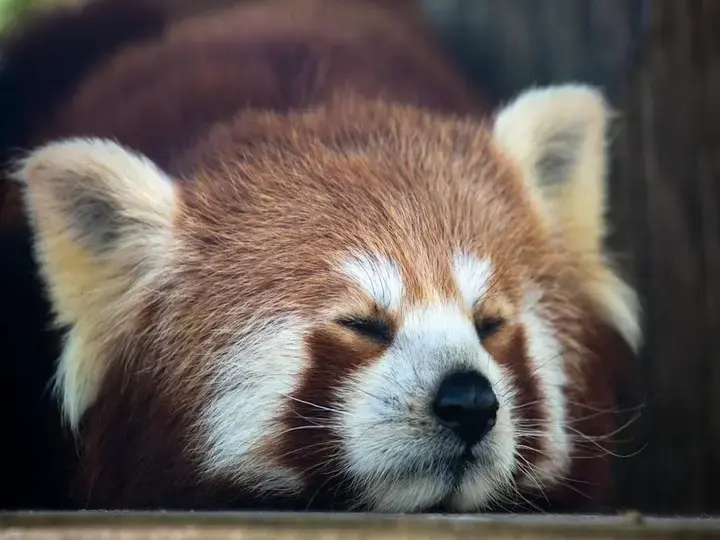
Logs, branches, and canopy structure are not decoration in its world. They are resting places, travel routes, cover from danger, and part of the cool forest structure the animal is built for. Softness, here, belongs to a specialist.
That is the real turn in the story. The problem is not simply that there are too few cute animals left. The problem is that red pandas are tied to high-altitude temperate forests with bamboo and tree-based shelter, so when those forests are fractured, the damage lands harder on them than on a more flexible species.
If you picture a zoo animal first, pause—can you picture the cold, high forest it actually needs?
A 2020 study in Habitat Ecology by Thapa and colleagues, working in Nepal's Jumla district, linked red panda presence to bamboo, forest cover, and nearby water while showing the animals avoided disturbed areas more than nearby available habitat would suggest. That sort of result is easy to remember because it matches the animal's whole design: eat in bamboo-rich places, rest in trees, keep to cool cover, avoid broken ground when possible.
Another useful piece came from Bista and co-authors in 2017 in PLOS ONE, who used field sign surveys in Nepal to show red panda occurrence was associated with bamboo and tree canopy, while human disturbance and livestock pressure shaped where the animals were less likely to be found. You do not need to read the paper to grasp the message. A red panda needs a working forest, not just leftover trees.
Why “Some Forest Left” Is Still Not Safe Enough
People often hear “habitat loss” and imagine a total clearing. But a red panda can be in trouble before that point.
When roads, fuelwood cutting, scattered development, or repeated disturbance split one stretch of forest from another, bamboo patches can become harder to reach and safe nesting sites harder to keep. Females need sheltered places such as tree hollows or dense cover for young. Animals moving between patches spend more time exposed. Small populations get cut off from each other.
That isolation is one reason conservation groups keep stressing connected habitat. The Red Panda Network, which works with community forests in Nepal, has focused for years on forest corridors for exactly this reason: a separated patch may still look green to us, but it may no longer function well for a red panda.
There are local differences, of course. A forest in Bhutan, a slope in eastern Nepal, and a mountainside in Sichuan are not all under the same pressure. But the common thread is easy to picture once you have it in your head: cool temperate forest, enough bamboo, enough trees, and enough connection that the animal can live as an animal of branches rather than a refugee hopping between scraps.
But Aren't Red Pandas Popular and Protected?
Yes, they are popular. Yes, many people know them from zoos. No, that does not mean they are secure in the wild.
Zoo visibility can trick the mind. An animal can be familiar to people and still be losing the exact habitat it depends on in nature. Red pandas are not in the same position as a common backyard creature that can nest in almost any patch of green.
One clarifying sentence helps here: despite the shared name, the red panda is not a small version of the giant panda's story. Its trouble is tied to its own mountain forest niche, where bamboo feeding, tree use, and habitat fragmentation all meet.
That is why conservation talk about red pandas keeps returning to forests rather than fame. Public affection helps only when it turns into protection for the places that keep wild animals wild.
The Part Worth Remembering After the Cute Wears Off
It is very easy to mistake charm for safety. The red panda's face invites softness from us, while its real life depends on a hard thing to preserve: intact, connected mountain forest with bamboo.
So the durable thought to carry away is simple. When those high forests stay connected, the animal has a chance to feed, rest, nest, and move as it should. When the forest is chopped into smaller pieces, the danger is no longer hidden behind the fur.
If you remember the red panda at all, remember it as a true creature of the high woods, not a cartoon, and you will already be closer to the truth that helps protect it.