Discover These Creatures Before They Disappear
One of the most recognizable little mammals on Earth can still quietly disappear. Red pandas, high in temperate mountain forests with bamboo across the eastern Himalayas and southwestern China, are listed as Endangered on the IUCN Red List, and their population trend is decreasing.
Önemli noktaları göster
- Red pandas are listed as Endangered on the IUCN Red List, with fewer than 10,000 mature individuals widely estimated in the wild.
- They live in temperate mountain forests with bamboo across the eastern Himalayas and southwestern China.
- Habitat loss and fragmentation are major threats because red pandas need connected canopy, den sites, and older trees, not just bamboo.
-
- Roads, development, livestock grazing, fuelwood collection, and expanding settlements reduce the quality and continuity of their habitat.
- Poaching and accidental trapping still harm some populations, even where habitat destruction remains the bigger threat.
- Research suggests red pandas may include two distinct species-level lineages, which could mean some populations are more vulnerable than previously thought.
- Public affection helps only when it leads to forest protection, habitat reconnection, and stronger enforcement against illegal trade.
That surprises people because the animal feels familiar the moment you see it. But familiarity is not protection. The 2015 IUCN Red List assessment, still widely cited, estimated fewer than 10,000 mature red pandas in the wild, and even that number comes with caution because this is an elusive species that is hard to count accurately across steep, broken forest.
Why a famous face can still vanish
I have watched children hurry through a zoo, looking for the loud animals first. Then one child finally stops, points up, and notices the red panda doing what red pandas often do best: staying almost still, tucked into the kind of branch that rewards patience.
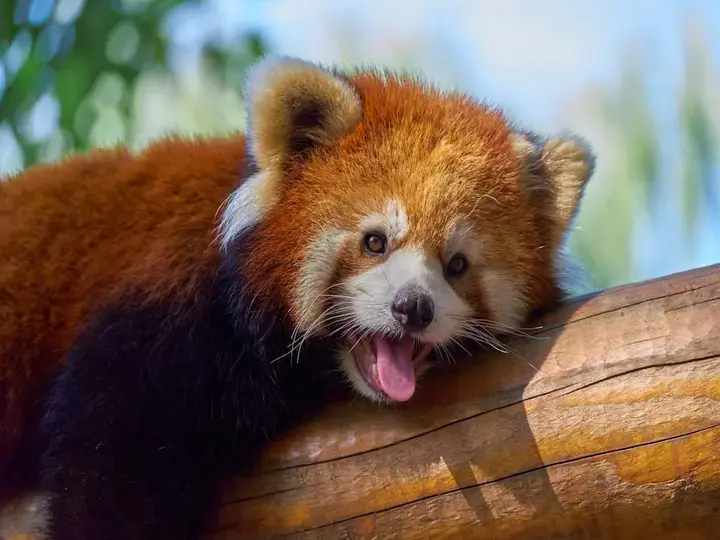
That moment matters because it teaches the wrong lesson if we are not careful. A red panda is easy to love once you have noticed it, yet in the wild it depends on very particular mountain forest conditions that are much easier to damage than the animal itself is to remember.
WWF describes the species as living in temperate forests with bamboo understory, generally in the eastern Himalayas and parts of southwestern China. Those forests need more than bamboo alone. Red pandas also rely on connected canopy, den sites, and older trees where they can rest, shelter, and raise young.
Put plainly, the animal is memorable, but its home is fragile. When forests are cut back, split by roads, disturbed by development, or reduced into smaller patches, red pandas do not just lose space. They lose the branch-to-branch continuity that lets them live like red pandas.
If you have ever steadied yourself against a tree to look up, you know the feeling of rough, ridged bark scraping lightly under your hand. That texture is a small reminder that a forest is built out of structure: trunks, forks, hollows, nesting places, cover, and the layered understory below.
For red pandas, structure is survival. Bamboo provides much of the diet, but the surrounding forest provides safety, movement routes, and nesting trees. Take away enough of that structure, and a forest can still look green while becoming much less usable.
If this red panda vanished tomorrow, could you describe its face from memory?
The harder thing to notice is what keeps it alive
Most people remember the feeling of seeing a red panda better than the conditions that let it survive. That is the trap. Recognizability does not protect a species; intact habitat does.
The IUCN assessment names habitat loss and fragmentation as major pressures. Forests are split, shrink, and isolate. A population that once had movement between patches can become boxed into smaller areas, which makes breeding harder, dispersal riskier, and local losses more serious.
Another pressure is the loss of older trees and nesting sites. Red pandas do not simply need bamboo somewhere nearby; they need forest with the right physical character. Human disturbance also matters, especially where roads, livestock grazing, fuelwood collection, or expanding settlement push deeper into mountain habitat.
There is also direct killing. Poaching and accidental capture in traps remain part of the problem in some areas, even if habitat change is the larger story. Conservation groups working in range countries have been saying for years that you cannot separate species protection from forest protection here.
Recent fieldwork backs that up. A 2020 study in Science Advances by Wei, Swaisgood, Hu, Zhu, and others argued that what had long been grouped as one red panda actually includes two distinct species-level lineages, which matters because smaller, separated populations can be even more vulnerable than people assumed. A 2021 camera-trap and habitat study from eastern Nepal published in Global Ecology and Conservation found red panda presence tied closely to bamboo cover, tree cover, and low disturbance, again pointing to habitat quality rather than public affection as the deciding factor.
Not every local population is collapsing at the same speed, and some habitat studies show mixed regional patterns, but fragmentation and habitat loss remain consistent threats across the species' range. That uncertainty is worth saying out loud because exact numbers are hard to track when an animal is shy, patchily distributed, and active in difficult terrain.
Why love is not enough on its own
It is comforting to think that a well-loved animal is a safer animal. Zoos help people care, and public affection does matter. I would never dismiss the power of a child stopping, looking up, and really seeing one.
But attention only helps when it turns into something on the ground. For red pandas, that means protecting and reconnecting forest, keeping bamboo-rich habitat from being cut into smaller pieces, supporting local conservation work in range areas, and enforcing rules against trapping and illegal trade.
That is the part many charming species reveal if you stay with them long enough: they are not saved by being adorable. They are saved when the places they depend on are left whole enough to keep supporting life.
The branch is still there, but not forever
Once you know this, the red panda feels a little different. Not less lovable, just more real. Endangered is no longer an abstract label attached to a familiar face; it is a sign that even a widely recognized animal can be lost quietly when its forest is split apart.
So the useful thing to carry away is simple: when you notice the red panda, notice the forest with it. Attention may seem small, but it is where protection starts, and it is how a shy animal on a branch stays part of the living world instead of just a memory people were sure would last.