Over 60 Years in the Making: The Nuclear Engine Set to Journey to Mars
For decades, scientists and engineers have looked for ways to make space travel faster and more efficient. Traditional chemical propulsion systems are reliable, but they have significant limits for deep-space missions. Now, after more than 60 years of research and development, NASA and DARPA are preparing to test a Nuclear Thermal Propulsion (NTP) engine — a technology that could cut the trip to Mars from about six months to just 45 days.
Development of Nuclear Space Propulsion
The idea of using nuclear power for space propulsion goes back to the 1950s, when the U.S. Air Force and the Atomic Energy Commission launched the Rover project to develop nuclear rockets. By the 1960s, NASA had taken over the effort, producing the Nuclear Engine for Rocket Vehicle Applications (NERVA). NERVA demonstrated nuclear thermal propulsion successfully, but funding cuts in the 1970s halted development before any flight tests took place. Interest in nuclear propulsion never disappeared, however.
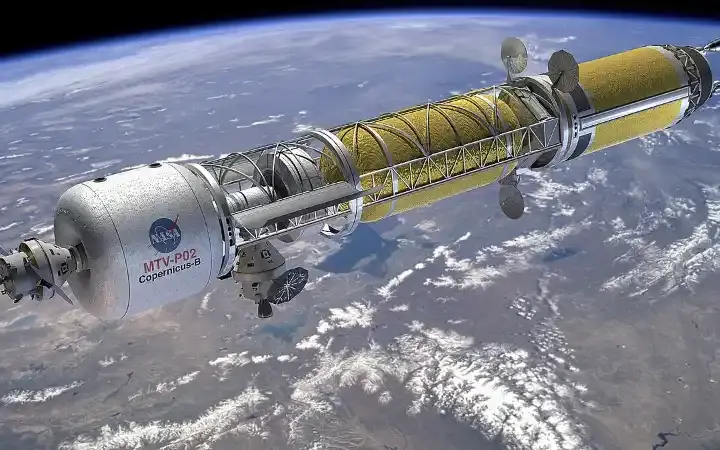
In recent years, NASA has revived its nuclear program with a focus on bimodal systems that combine Nuclear Thermal Propulsion (NTP) and Nuclear Electric Propulsion (NEP). This approach could enable faster, more efficient travel, making missions to Mars and beyond more feasible. Renewed interest is driven by the need for long-duration spaceflights: chemical rockets require enormous amounts of fuel, which makes deep-space travel impractical, while nuclear propulsion offers a much higher energy density so spacecraft can travel farther with less propellant.
How Nuclear Thermal Propulsion Works
Unlike chemical rockets that rely on combustion, a nuclear thermal engine uses a reactor to heat a propellant, usually liquid hydrogen. The heated hydrogen expands and is expelled through a nozzle to produce thrust. This method is far more efficient than traditional chemical propulsion, allowing spacecraft to go farther using less fuel. A major advantage of nuclear thermal propulsion is its high thrust-to-weight ratio, which enables faster acceleration. Reaching Mars in about 45 days would also reduce astronauts’ exposure to cosmic radiation and the health effects of prolonged microgravity.

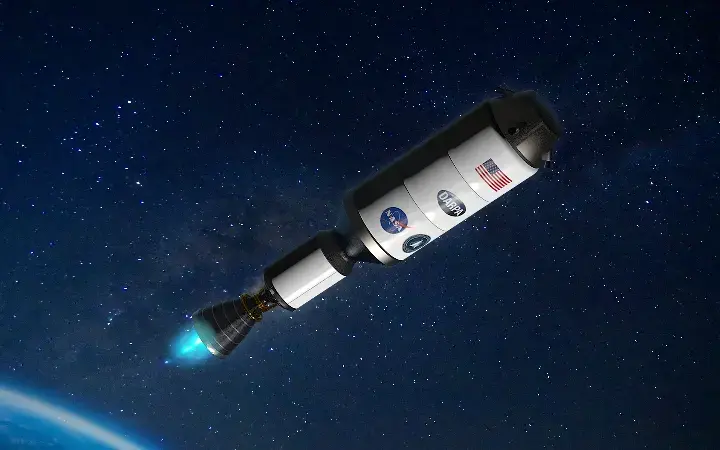
The Demonstration Rocket for Agile Cislunar Operations (DRACO) program, a joint effort by NASA and the Defense Advanced Research Projects Agency (DARPA), aims to test an NTP engine in space by 2027. If the test succeeds, the technology could transform interplanetary travel and pave the way for human exploration of Mars and other destinations. Nuclear propulsion could also support deep-space missions to Jupiter, Saturn, and beyond, allowing scientists to explore distant worlds, search for signs of life, and extend humanity’s presence in the solar system.
Challenges and Future Prospects
Despite its potential, nuclear propulsion faces several major challenges. Radiation safety is a primary concern for both crew and the environment, so engineers must design effective shielding to protect astronauts from reactor emissions. Heat management is another issue: nuclear reactors produce extreme temperatures that require advanced cooling systems to prevent overheating. Spacecraft materials must also resist prolonged exposure to high-energy radiation without degrading.
Progress is ongoing. Companies such as General Atomics are developing materials that can withstand the harsh conditions of a nuclear engine, and recent tests have shown promising results. NASA is also working on automated reactor shutdown systems to allow spacecraft to power down safely in an emergency, which is crucial for astronaut safety and accident prevention. Public perception remains a hurdle: nuclear technology is often associated with risk, and convincing the public of its safety will be important for broader acceptance. NASA and DARPA are conducting extensive research to demonstrate the safety and effectiveness of nuclear propulsion.
The Future of Space Exploration
If nuclear propulsion proves practical and safe, it could change space travel dramatically. Trips to Mars that now take six to nine months might be cut to a few weeks, making sustained settlement more practical and opening the door to deeper exploration. Faster travel would also make missions to moons like Europa and Titan more feasible, allowing scientists to conduct more detailed studies and increasing the chance of finding signs of life beneath icy surfaces. As NASA and DARPA prepare for the first in-space test of a nuclear thermal rocket, the long-standing goal of reaching Mars more quickly feels closer than ever. After more than six decades of development, nuclear propulsion may soon reshape how we travel and explore the solar system.